Eighteen months ago, I asked whether Peter Thiel should leave the United States after he told Joe Rogan he felt “trapped” in America, torn between fleeing California and fleeing the country. He has since stopped debating.
Peter Thiel could live anywhere on Earth. That is not a figure of speech. With a fortune Forbes pegs at roughly $28 billion USD, the man has the means to wake up tomorrow in Monaco, Singapore, Zurich, or on a private island with its own zip code. He has already obtained New Zealand citizenship and reportedly holds a Maltese passport. The whole world is his to choose from.
So why has he spent this spring planting flags in two of the not-very-obvious countries on the map? He moved his family to Argentina in April 2026. A few weeks later, he was in Asunción, talking to the president of Paraguay.
Why would a man who can live anywhere, already holds a second passport, and has no shortage of options, move his family to a country that has defaulted on its sovereign debt nine times? Then pay a visit to President Pena of Paraguay to discuss investment options.
In this article, I'll go over who Peter Thiel is, what his moves signal to expats, and how the Southern Cone is becoming a hot spot.
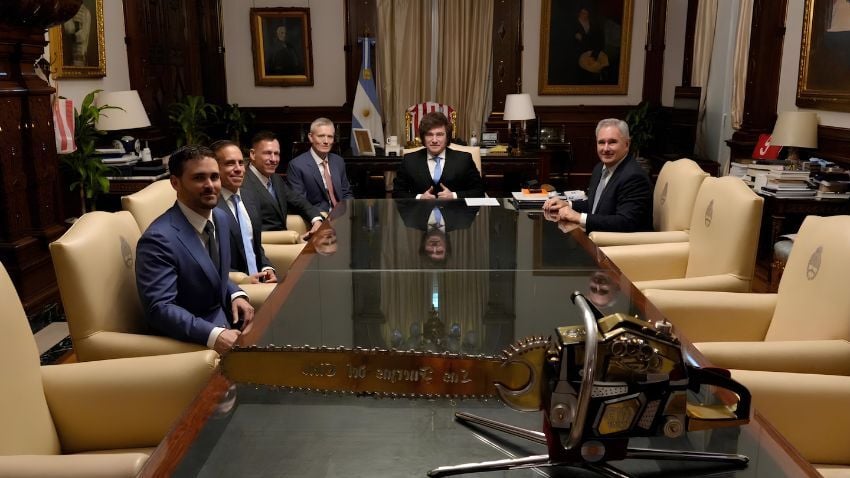
By relocating to Buenos Aires and forging closer ties with Javier Milei’s inner circle, Peter Thiel is signalling that his bet on Argentina extends far beyond business
PLANTING FLAGS IN SOUTHERN CONE
Let’s start with Argentina, because that is where he actually moved. News reports say Thiel has begun living in Buenos Aires with his family, and the children are enrolled in a local school. The property itself is worth attention, as well. He reportedly paid about $12 million USD for a 17,200-square-foot, Alejandro Bustillo-designed mansion in Barrio Parque. This is a 110-year-old historic district where tall buildings are banned, and embassies share tree-lined streets with Argentina's old aristocratic families. Homes of this calibre almost never come to market, and the sale set a new record for one of Buenos Aires' most coveted neighbourhoods.
Of course, he didn't arrive as a stranger. Thiel has been a vocal admirer of President Javier Milei, the self-described anarcho-capitalist who has become a hero among Silicon Valley libertarians for his economic reform program. According to regional reports, Thiel's itinerary read like a state visit, lunch with presidential adviser Santiago Caputo, dinner at a cabinet minister's home, and a night at the derby between Boca and River.
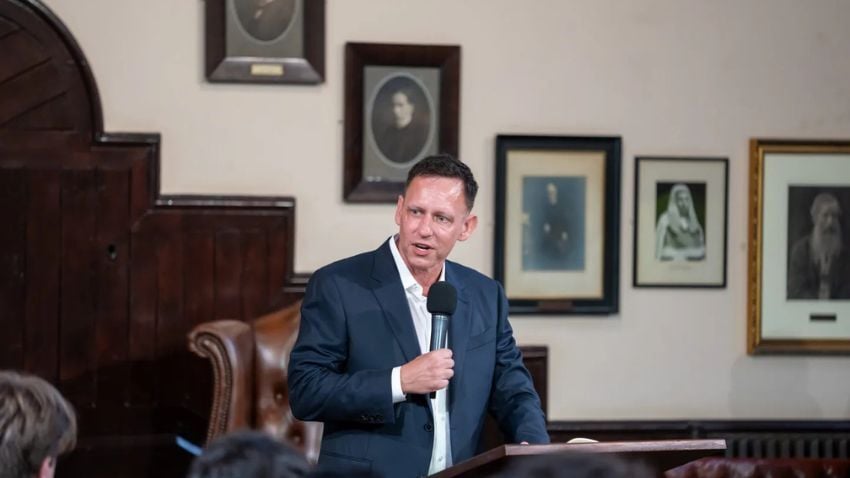
Then came Paraguay. There, he met President Santiago Peña at the presidential residence, where the two discussed the opportunities the country offers in artificial intelligence, energy, and financial technology. Peña called him “one of the world's most visionary investors” and pitched Paraguay as a destination for long-term capital. For now, there is no house or relocation. Just a billionaire evaluating an energy independent, politically and economically stable, pro-market, open country, which is getting enormous attention from the world.
What explains Peter Thiel's sudden interest in the Southern Cone?
THE MAN WHO SHOWS UP BEFORE THE TREND DOES
Before I answer that, you need to understand who is doing the buying. Because the answer only matters if the buyer's judgment is worth tracking. Thiel's is. Here's why.
In 2004, a scrappy company called Facebook was being run out of what looked more like a dorm room than a business. Most serious investors saw a college fad. Thiel saw something else and wrote the first outside check, $500,000 USD for roughly 10% of the company. The consensus was that social networking was a toy. The consensus was wrong, and Thiel was early.
He had already done it once. PayPal, which he co-founded in 1998, survived the dot-com bust and was sold to eBay for $1.5 billion USD in 2002. Those were the days when “send money over the internet” sounded to most people like a recipe for getting robbed. That single company seeded a generation and helped spark much of modern technology, and Thiel sat at its center.
Then he did it a third time, and this one was the least obvious of all. In 2003, he co-founded Palantir, a data analytics company originally built to serve U.S. intelligence agencies. Today, Palantir is a major government and defence contractor, and it anchors a fortune Forbes put at roughly $28 billion USD in 2026. Can you see the pattern yet? The entire Thiel playbook depends on finding the thing the consensus is mocking, and buying it before the rest of the world catches up.
A CONTRARIAN FIGURE
Peter Thiel is not a beloved figure for everyone. He is a libertarian who has poured substantial money into right-wing figures and causes, enough to make him a hero to one political tribe and a bogeyman to the other. Palantir, the company he co-founded to serve U.S. intelligence agencies, has become one of the most powerful surveillance and defence contractors on the planet. Depending on where you sit, that makes him either the man keeping the West safe or the man building the machinery of the security state. He wrote Zero to One, a venture-capital bible that half of Silicon Valley quotes and the other half rolls its eyes at.
WHAT HE IS ACTUALLY DOING
If you strip away the mansion, the politics, and the billionaire theatre, you are left with a strategy. What makes it powerful is that it is repeatable. How do I know? I have been crying the same strategy for years from the rooftops. That's the strategy Expat Money builds for people with the same problem Thiel is solving: too much of their life inside one government's reach.
Thiel is hedging geopolitical risk. The first principle of protecting wealth is brutally simple: don't keep everything you own, and everyone you love, inside one jurisdiction. Diversifying your portfolio isn’t enough without jurisdictional diversification if your goal is to build financial independence and freedom from arbitrary political oppression. Thiel is spreading the surface area so no single government's bad decision can touch everything he has built.
New Zealand is a safe haven and a point of escape. Argentina is a personal flag, where he physically moved his family there, betting on a recovery while the entry price is still low. Finally, Paraguay is a capital flag. He's been waiting for the right opening in a country whose government is actively courting exactly the kind of long-term capital he deploys. This is not a man buying houses, but a man building a portfolio of jurisdictions, each a hedge against a different way the world could go wrong.
Of course, Thiel is not a financial adviser, and he can afford to be wrong in ways you may not. If his Argentina bet sours, he loses a rounding error and keeps two other passports. If your Plan-B is built on a single roll of the dice, a bad outcome lands very differently.
What I am telling you is to read the signal correctly. The takeaway is that the sharpest, most contrarian capital on earth is quietly diversifying out of the obvious jurisdictions and into the overlooked ones. You just need to understand why a man who can see around corners is positioning before the corner is turned.
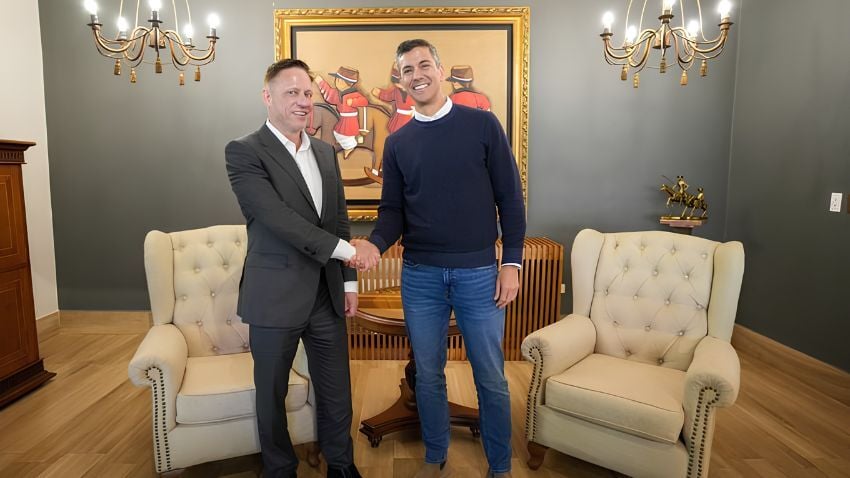
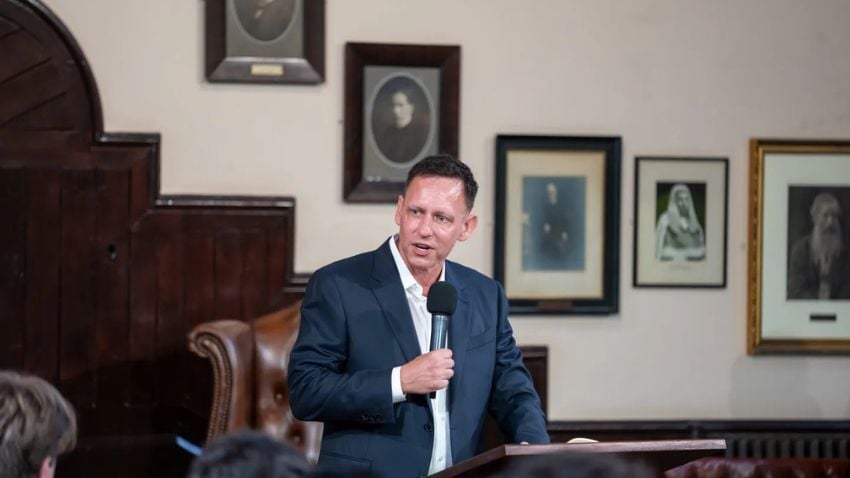
Paraguay's President Santiago Peña and Peter Thiel explore investment and innovation opportunities in the country
WHY THE SOUTHERN CONE SHOULD BE PART OF YOUR PLAN-B
You don't have to be Peter Thiel to play the same game. What he is doing is one data point inside a regional shift I have been tracking for years. Across Latin America, voters have spent the last several election cycles throwing out socialist governments and replacing them with leaders promising security, sound money, and functioning markets. Argentina, El Salvador, Ecuador, Chile, Honduras, and Bolivia are all joining countries like Paraguay, Panama, and Costa Rica that were already well-positioned. As I argued in my piece on Latin America's right turn, this is a correction, not a pendulum swing, and the longer the order holds, the harder it gets to reverse. Milei's Argentina is the loudest example of it, but it is an example, not an exception.
On the other hand, the Southern Cone is the southernmost region of South America: Argentina, Paraguay, Uruguay, Chile, and the southern parts of Brazil. Thiel did not invest randomly in Latin America. He made both of his investments in this single subregion, specifically in Argentina and Paraguay, two neighbouring countries that share a river and the dams built on it.
There is a second force working in your favour. In March 2026, seventeen countries gathered at the Shield of the Americas summit in Miami to launch a U.S.-backed coalition aimed at dismantling the drug cartels and organized crime. On the surface, it is a security pact. Underneath, it is Washington reasserting itself in its own hemisphere after two decades of letting China quietly build the ports, finance the dams, and lock up the critical minerals. Both Argentina and Paraguay were at that table. The countries inside this coalition are positioning themselves for preferential U.S. investment, trade terms, and security cooperation.
Therefore, although the transformation in Argentina has not yet fully taken place, the pro-market, pro-security shift has already begun to have an impact in the wider region. Thiel invested in the most dramatic, high-variance corner of a movement that had already begun.
However, Paraguay is a totally different story from Argentina. There might be a specific reason why President Peña is courting men like Thiel. Artificial intelligence runs on electricity, vast, relentless quantities of it, and the entire industry is hitting an energy wall. Data centers from Virginia to Singapore are straining local grids to the breaking point. Power, not chips, is becoming the real bottleneck of the AI age.
Now look at Paraguay. The country generates nearly all of its electricity from clean hydroelectric power, chiefly the binational Itaipú dam, a 14,000-megawatt giant. Paraguay uses only a fraction of its share. The half of Itaipú alone could power the entire nation roughly three times over. What is even more interesting is that Itaipú isn't even the whole story. Paraguay co-owns a second major dam, Yacyretá, with Argentina, and there too it consumes only a slice of what it's entitled to. That is one of the largest untapped clean-energy surpluses on Earth, available at some of the lowest rates in the hemisphere. For decades, Paraguay simply sold that surplus cheaply to its neighbours, Brazil to the east, Argentina to the south. Now, the government wants to keep energy within the country and export the computing power. By early 2026, the government formalized this by fixing preferential dollar-based electricity tariffs for up to 15 years for AI and cloud operators.
Peña has been aggressive about it, and he has even signed a deal with Taiwan to build what he calls the world's largest AI hub. That is the context for the Thiel meeting. A country that was a quiet agricultural backwater is positioning itself as the energy backbone of the AI economy. When a man who built Palantir starts paying attention, you should too.
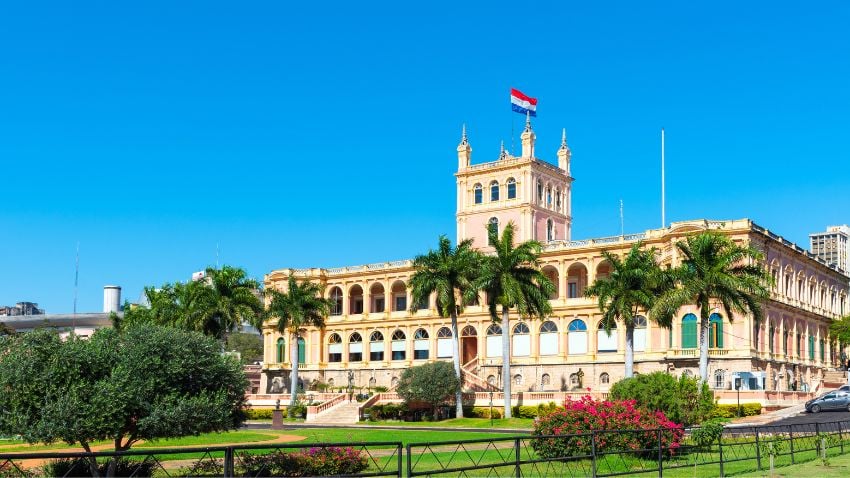
Paraguay is a no-brainer Plan-B with a territorial tax system, an easy residency path, and market-friendly policy.
CONCLUSION
You don't need to be a billionaire to create a Plan-B to protect your assets and freedom. However, you should be selective about the countries you choose. While I keep my hopes high for Argentina, as a safer option, I recommend destinations that have proven themselves to expats over many years.
Several jurisdictions in Latin America are great to act on right now. Paraguay is a no-brainer Plan-B as the hemisphere offers: one of the most accessible residency programs anywhere, a territorial tax system that simply leaves your foreign income alone, and a government that has held to rule-based, market-friendly policy for decades. Panama is the other anchor, which is a fully dollarized economy without a central bank, a residency system tailored for the internationally mobile, and a president focused on stability, secure borders, and openness to global capital. Neither is a gamble on a turnaround. Both already work.
Thiel has a team composed of lawyers, tax strategists, residency specialists, and people whose entire job is to structure his long-term strategy. Those resources and the people are the actual reason a man can move his family across the world in a single, clean decision.
Again, you don’t have to be a billionaire to have a team, helping you plan and execute your Plan-B. Expat Money helps individuals and families build exactly this kind of jurisdictional diversification, a real second base, structured properly, in the places across Latin America that make practical sense for your situation rather than a billionaire's. You can start building your Plan-B, tailored for your needs and preferences, before you ever need it. If you don’t know what your first move will be, download our free special report on "Plan-B Residencies & Instant Citizenships."

















 Mikkel Thorup: June 15, 2026