As I write this, Bolivia is once again at the centre of political turmoil. Following weeks of protests and road blockades that cut off supplies to La Paz, Congress has authorized President Rodrigo Paz to use the military to restore freedom of movement on the country's roads. If you have been following my coverage of Bolivia, from the bizarre failed coup in June 2024 to the historic election of Rodrigo Paz in October 2025, none of this will surprise you.
However, if you are not looking closely, you may be missing an important point. Behind the noise, Bolivia is undergoing the most significant economic and political transformation in its modern history.
After nearly two decades of socialist mismanagement under the Movement for Socialism (MAS), Bolivians have chosen a fundamentally different path with a market-oriented president in power, and they are not alone in this direction in the region. Now, a broader right-wing shift is sweeping across Latin America.
A reform agenda is on the table, and for expats and investors who understand how emerging markets work, Bolivia may present one of the most compelling early-mover opportunities in the Western Hemisphere. To be clear, this is not a country that's ready to be packaged and sold as an expat destination. It's messy and volatile, and it's going through major growing pains.
However, it also has a territorial tax system that doesn't tax your foreign income and a president who is actively working to dismantle the command economy and open Bolivia to the world. If you know how to read the signs, you'll understand why I believe Bolivia deserves your serious attention.
In this article, I'll give you everything you need to know: the political background, the reform agenda, the tax system, and the country's safety situation.

After two decades of socialist rule, economic decline, and political turmoil, Bolivians voted for change. Rodrigo Paz's victory marks a decisive break from the MAS era and a new direction for the country
FROM MORALES TO PAZ: HOW BOLIVIA BROKE FREE FROM SOCIALISM
To understand where Bolivia is going, you need to understand where it has been. Bolivia’s recent history has been a cautionary tale about what happens when socialist politicians gain power and refuse to let go.
Evo Morales came to power in 2005 as Bolivia's first indigenous president, and his election was a historically significant moment in a country where 62% of the population is indigenous. His party, the Movement for Socialism (MAS), promised the usual false promises of redistribution. Morales built a command economy, dragged the economy into chaos, eroded the constitutional order, and created a political class that treated the state as its personal property. He declared himself as a presidential candidate for a fourth term despite losing a referendum on whether he should be allowed to run again.
Then, protests erupted in 2019, and he fled to Argentina. However, his party's candidate, Luis Arce, won the 2020 elections. Shortly after, Morales returned to Bolivia and announced he would run again in 2025.
Even though Arce became president, the economy and social order continued to decline rapidly. In the middle of the usual chaos, a bizarre coup attempt happened. It looked like an ordinary coup until General Zuniga was stopped by Arce with reporters surrounding him in the government palace. Whether it was a real coup or a staged show to boost Arce's popularity isn’t important. However, the weird coup attempt was obviously evident that Bolivia was dragged into institutional collapse under a twenty-year socialist regime.
However, the failed coup couldn't save MAS. Because the MAS couldn’t field a candidate in the 2025 presidential elections. Morales didn’t have the right to run, and Arce withdrew his candidacy due to corruption allegations.
Eventually, Rodrigo Paz won by securing 54.6% of the total vote. Young people, professionals, and urban voters who had grown up under MAS rule seized control of the political scene.

After decades of socialist rule, voters chose a new path. The rightward shift across Latin America continues
BOLIVIA AND LATIN AMERICA'S RIGHT TURN
Bolivia's transformation is part of the most significant political realignment Latin America has seen in a generation. The wave of socialist governments that swept the region in the early 2000s, starting with Hugo Chavez in Venezuela in 1998 and spreading to Brazil, Argentina, Bolivia, and Ecuador, is over. It didn't just fade. It was rejected at the ballot box, decisively and repeatedly.
In 2025 alone, the pro-market leaders won all four presidential elections held in the region. Chile elected José Antonio Kast, a firm conservative, with the largest vote total ever recorded in a Chilean presidential election. Honduras elected Nasry Asfura. Ecuador's Daniel Noboa was already in power. Finally, Bolivia elected Paz. You can add to this Javier Milei in Argentina, Nayib Bukele in El Salvador, Santiago Peña in Paraguay, Luis Abinader in the Dominican Republic, and José Raúl Mulino in Panama. The trend is not slowing down. Costa Rica already elected a right-wing president, Laura Fernández, in February 2026. The picture is unmistakable: 10 Latin American countries are now governed by right-leaning and pro-market presidents. This trend is comparable to the wave of market-oriented reforms of the 1990s.
I am not at all surprised by this. I have said for years that socialism would end in disaster, and it has most spectacularly in Venezuela, but also in Argentina, Bolivia, and everywhere else it was tried. The so-called "new" socialism was never new. It was the same old command economy dressed in softer rhetoric, and it produced the same old results: poverty, corruption, institutional decay, and political instability.
PAZ'S REFORM AGENDA: BUILDING A MARKET ECONOMY FROM THE GROUND UP
Rodrigo Paz is 58 years old, the son of former President Jaime Paz Zamora, an economist trained in the U.S., and a former mayor of Tarija and senator. He is not a revolutionary or a populist. He is a practical statesman with a clear understanding that Bolivia needs a functioning market economy.
"Ideology doesn't put food on the table," Paz told his supporters during the campaign (I couldn’t agree more, by the way). "What matters are jobs, strong institutions, legal security, and respect for private property." That is why economic liberalization is his top priority. Paz plans to simplify taxes, reduce bureaucracy, and help the millions of Bolivians working in the informal economy transition into the formal sector. This alone would be transformative. Informal economies aren’t signs of entrepreneurial failure, but signs of regulatory failure. When the state makes it too expensive and too complicated to operate legally, people work outside the system. Paz understands this.
Reestablishing fiscal discipline is Paz’s other goal. Bolivia's public debt reached around 80% of GDP under the MAS, which isn’t normal for a developing country with abundant, valuable natural resources. Paz aims to cut wasteful subsidies, particularly fuel subsidies that are draining public finances, but the riots have stopped him for now.
Bolivia has nearly a third of the world's lithium reserves, one of the largest natural gas deposits in South America, and significant gold, iron, and mineral resources. These were managed through state monopolies that failed to attract the investment and technology needed to develop them for decades. Paz’s plan is to open these sectors to private and foreign investors to increase funds and effectiveness. Bolivia’s future depends on its success in raising revenues from the mining sector.
However, what is even harder to achieve is to reinstitute the rule of law in Bolivia. Strengthening judicial independence, fighting corruption through, and rebuilding public trust in institutions are priorities of the new president. Paz appears to understand that without the rule of law, none of the economic reforms can take root.
Finally, Paz supports trade openness. He intends to rebuild relationships with regional and global markets through new investment treaties and infrastructure projects that connect Bolivia to its neighbours. His foreign policy represents a clean break from the Morales era, meaning no more anti-Western rhetoric and alignment with Caracas and Moscow. Bolivia has already signed open skies agreements with Panama and Paraguay, and international airlines are expanding their routes to the country. As Paz told El País: "I hope Bolivia returns to the world, and that the world returns to Bolivia."
Again, I couldn’t agree more with Paz.
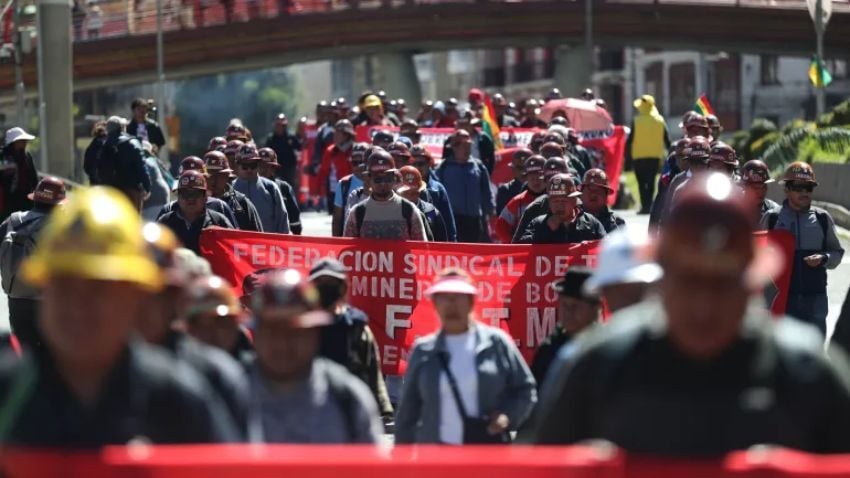
The Old Guard Fights Back, as Bolivia pushes for change, unrest returns to the streets
RIOTS ON THE STREETS ONCE MORE
As of June 2026, Bolivia is in the middle of yet another political storm. Morales is directing operations from his hideout in Bolivia's remote Chapare province while evading an arrest warrant. He has issued a 90-day ultimatum to the Paz government to hold new elections and resign, or face coordinated escalations.
More than a month of road blockades led by farmers, miners, transport workers, teachers, and the Bolivian Workers' Central have disrupted transportation networks across the country amid what many describe as Bolivia's worst economic crisis in four decades. The blockades have severely affected the movement of food, fuel, medicine, and other essential goods, placing increasing pressure on the government to restore order and prevent further economic damage.
The protests were initially triggered by two of Paz's reform moves, the elimination of a two-decade-old fuel subsidy and a land reform law that indigenous groups saw as a threat to their holdings. Paz has since repealed the land law and announced a cabinet reshuffle with a permanent dialogue framework, but the protests have expanded into broader demands for his resignation.
The standoff escalated further on June 7 when Bolivia's Congress approved legislation authorizing President Paz to use the military to clear blocked roads. Supporters argue that restoring freedom of movement and supply chains has become a matter of national necessity after weeks of economic disruption, while critics warn that military involvement could further inflame tensions and deepen the political crisis.
None of this surprises me. Morales has shut Bolivia down before. He did it to Arce in 2024, then in 2019, and now, he is doing it again. What is different this time is the international response. The U.S. has openly backed Paz, and Milei sent military cargo planes with humanitarian aid. Paraguay, Chile, Peru, Ecuador, Costa Rica, Panama, and Honduras issued a joint statement of solidarity with the Paz government. Although Morales' ultimatums are not empty threats, Paz has the support of the full weight of the regional right-wing bloc and Washington behind him.
I believe this is where the Shield of the Americas comes into play. President Trump hosted the inaugural Shield of the Americas Summit in Doral, Florida, in March 2026. This is a new multinational coalition of 17 nations designed to replace the old Summit of the Americas with a security-first, like-minded alliance. Paz was there, standing alongside Milei, Bukele, Noboa, Peña, and Kast for the family photo. Bolivia signed the joint security declaration. The coalition is officially about counter-cartel operations and intelligence sharing, but its real significance is political, as a standing alliance of right-leaning governments that have each other's backs. When Morales launched his blockades in May, that alliance moved to help Paz. It seems that Bolivia is no longer isolated, but is getting embedded in a regional power structure.
BOLIVIA'S TERRITORIAL TAX SYSTEM
Now let's talk about taxes. Bolivia's territorial tax system is, in my view, one of the most underrated tax structures in the Western Hemisphere. It is not marketed, but the substance is there, and for the right person, it is remarkably compelling.
Another tax advantage of Bolivia is that there is no capital gains tax at the individual level. Not implementing CRS (Common Reporting Standard) or CARF (the Crypto-Asset Reporting Framework) by 2026 can also be seen as a significant advantage. Thus, Bolivian banks don’t automatically share account information with foreign tax authorities. Additionally, Controlled Foreign Corporation (CFC) rules don’t apply there as well. If you hold foreign companies as resident in Bolivia, those companies' profits aren’t taxed in Bolivia. Finally, there is no deemed disposition of assets and no departure capital gains levy if you leave Bolivia.
The picture is particularly interesting for crypto holders. Bolivia legalized cryptocurrency services in 2024, and the Ministry of Economy authorized all banks to offer crypto-related services in 2025. Additionally, you don’t need a private wallet or an established crypto enforcement framework. Banco Bisa has already launched a live USDT custody service.
However, there is one red flag that expats should be careful about. Bolivia has a wealth tax called the IGF (Impuesto a las Grandes Fortunas) that applies to worldwide assets for residents. If you spend more than 183 days in Bolivia in any 12-month period, you are considered a resident for IGF purposes. The wealth that counts includes real estate, movable property, luxury goods, financial assets, cash, and any other asset with economic value. However, Paz is currently working to abolish the IGF entirely.
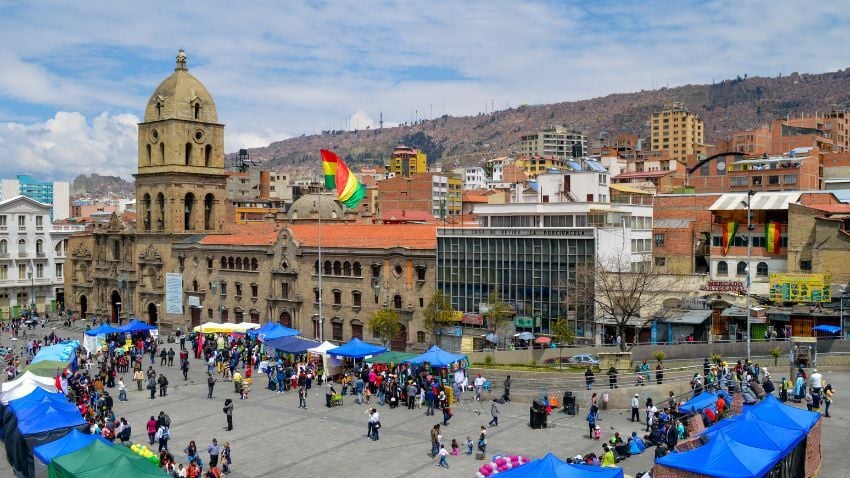
Watch This Country Closely, Bolivia is not a top expat destination today. That could change faster than most people think
IS BOLIVIA SAFE FOR EXPATS?
According to Numbeo, Bolivia has a Crime Index of 64.19 and a Safety Index of 35.81. Corruption is perceived as very high at around 87. The safest cities are Sucre and Tarija, with crime scores around 50. Bolivia's homicide rate is approximately 3 per 100,000 people. That is significantly lower than Brazil (around 15), Colombia (around 25.5), or Mexico (around 28). This is because cartel violence is not as common as in some of the countries in the region. However, the primary safety concerns are petty crime, such as pickpocketing, bag snatching, and opportunistic theft.
The expat-friendly neighbourhoods in Santa Cruz (Equipetrol, Urubo, Las Palmas), La Paz (Calacoto, San Miguel, Zona Sur), and Cochabamba (Cala Cala, Queru Queru) are considerably safer than the national averages suggest. These are gated communities and well-policed areas where many affluent Bolivians and expats live. However, wherever you are, you should take your common-sense precautions seriously, avoiding flashy displays of wealth, not walking alone at night in unfamiliar areas, and using rideshare apps instead of unmarked taxis.
Bolivia is not the safest country in Latin America, but violent crime is quite low. With proper awareness, the right neighbourhood, and sensible precautions, you can feel safe in your daily life.
CONCLUSION
Although Bolivia is not a country I currently recommend for residency or citizenship, it does have many appealing qualities for expats that - should the overall situation in the country improve - could make it worth a harder look down the road. The territorial tax system alone puts Bolivia in an elite category. Bolivia does not participate in automatic information sharing, has no capital gains tax for individuals, and has no Controlled Foreign Company (CFC) rules.
I have spent over 25+ years helping people build their Plan-B strategies, and the single most important lesson I have learnt is that the best opportunities are never obvious. By the time a country becomes a mainstream expat destination, the low-hanging fruit is gone. If you'd like to stay updated on the latest expat news, subscribe to our free newsletter.
As residency programs become more expensive, real estate prices rise, the regulatory environment tightens, and the early-mover advantage disappears. History has shown that the best way to protect your freedom and your wealth is to have alternatives.
Bolivia could become one of those alternatives, but it's one to watch from a distance for now. If you haven’t built your Plan-B yet, it is the perfect time to start your journey by downloading our free report on Plan-B Residencies & Instant Citizenships.





















 Mikkel Thorup: October 06, 2026