Argentina is a diverse and attractive country that is often compared to Europe in terms of culture and architecture. The nation offers a financial alternative to persons who desire to retire in Europe but cannot afford the living expenses. If you want to live your golden years in this beautiful country, you should apply for a Retirement Visa.
Retiring in Argentina is a dream come true for many individuals seeking a high quality of life at an affordable cost. With its stunning landscapes, vibrant cities, and rich cultural heritage, Argentina has become a popular destination for retirees from around the world.
The climate and weather in Argentina are also a major draw for retirees. With a wide range of climates throughout the country, you can choose to live in a location that suits your preferences. Whether you prefer the warm and sunny beaches of Mar del Plata or the cooler temperatures of Bariloche, there is a climate for everyone in Argentina.
By early 2026, Milei's administration had eliminated the national budget deficit, passed sweeping labour market reforms, announced 90 legislative reform initiatives for 2026 alone, and driven monthly inflation down from a peak of 25.5% in December 2023 to approximately 2.9% in January 2026.
According to the OECD's most current projections (December 2025), Argentina's real GDP is expected to grow 4.2% in 2025 and 3.0% in 2026, before accelerating to 3.9% in 2027. The IMF projects 2026 real GDP growth at 3.5%. BBVA Research (March 2026) projects moderate growth "driven by exports, investment and consumption.
Annual inflation peaked at approximately 254% in Milei's first month and, as of March 2026, stood at 32.6%, down from 118% at the end of 2024. The IMF projects 30.4% average inflation for 2026, while the OECD projects 17.6%. Analysts project a single-digit inflation by 2027.
ARGENTINA RETIREMENT VISA
Argentina now provides retirement visa alternatives for expats. Apply for an Argentinian retirement visa (Pensionado Visa) to retire in Argentina. A Pensionado Visa is a temporary residency visa that permits you to relocate to Argentina and remain there for the duration of your retirement. This visa applies specifically to individuals receiving a formal government pension, military retirement, Social Security benefit, or equivalent income from a regulated retirement system. Requires a minimum of approximately USD $2,000/month (recommended threshold). Does not permit employment in Argentina, but allows operating a business independently. It should not be confused with the Rentista Visa, which applies to passive investment income.
Retiring in Argentina also offers financial benefits. The government does not levy taxes on regular income from savings, making it an attractive option for retirees looking to live off their savings. However, if you decide to work again, income taxes will apply based on a progressive scale, ranging from 9% to 35% depending on your net income.
Safety is another important factor to consider when retiring abroad. While crime can be a concern in some areas of Argentina, the overall safety level is reasonable. Police patrols are regular, particularly in popular expatriate neighbourhoods, and public security in big cities is generally excellent. It is always advisable to take precautions against theft and avoid public protests or strikes.
Related content: The Basics Of How To Get A Second Passport Or A Second Residency
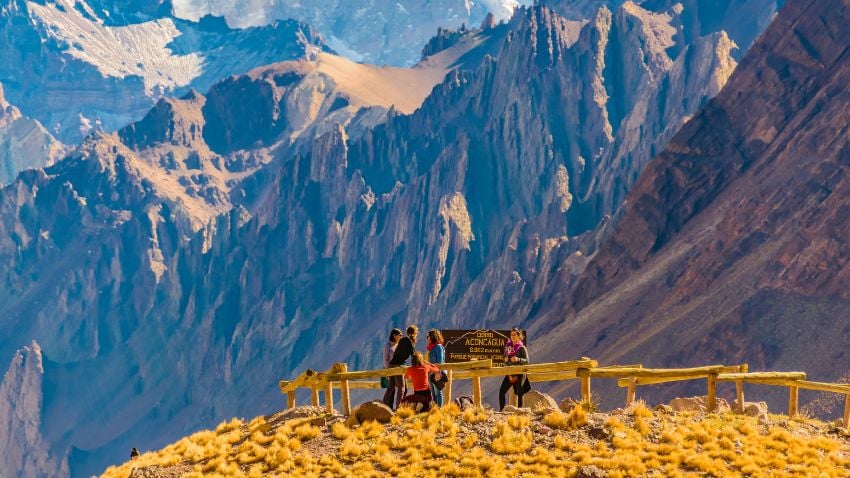
Aconcagua National Park, Mendoza, Argentina
REQUIREMENTS FOR OBTAINING AN ARGENTINA RETIREMENT VISA
The first thing to look out for is the age limit specified, as the retirement age for men and women in Argentina is 65 and 60, respectively.
Upon meeting the age criteria, the Argentine government wants you to receive a monthly pension of at least 30,000 Argentine pesos (around $1,400-$2,000 USD). You must additionally demonstrate that you get this amount as a pension or retirement benefit from a government agency or an international organization.
Dependents: Expect to show an additional $500-$1,000 USD per dependent to ensure financial solvency.
Related article: Obtaining Citizenship In Argentina Through Naturalization
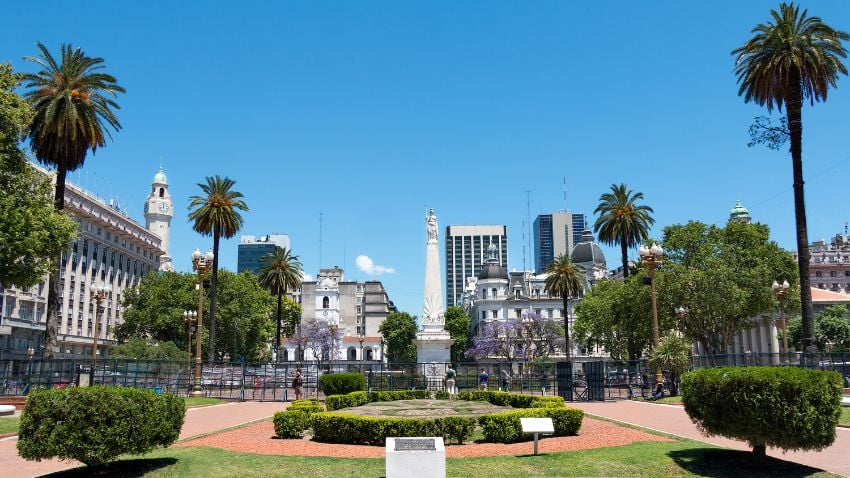
Plaza de Mayo, Buenos Aires
STEP-BY-STEP PROCEDURES FOR APPLYING FOR AN ARGENTINA RETIREMENT VISA
Your presence in Argentina is essential, as most stages of the process require you to be physically in the country. Depending on your nationality, you may either obtain an Argentine visa in advance or enter visa-free if you are exempt from visa requirements.
You can begin the process remotely by accessing the RaDEX system. First, create a user account, complete the application form, and pay the applicable fees. Be sure to upload all required documents and information based on the type of residency you are applying for.
If you meet the initial requirements, you will receive an email confirming the date of your in-person appointment. After that, you can continue uploading any additional documents or information through the system, which typically takes only a few minutes.
The required documents include:
- A valid and authentic passport
- A clear criminal record report from your home country
- An entry stamp for the nation, which should be on the travel document.
- Proof of obtaining a pension from the organization where you worked and retired. This documentation must demonstrate that you get an annuity upon retirement and the amount, timing, and length of your pension.
- A certificate including your name, residence, and utility bill.
- Argentine Criminal Record Certificate issued by the National Registry of Recidivism (Only required for those over 16 years of age) – Incorporated into the Radex system, it is not necessary to process it outside.
You should note that all documents must be legalized or apostilled by the Argentine Consulate in the issuing nation unless your country has ratified the Hague Convention. Documents submitted in a foreign language must be approved by the Association of Translators and translated into Spanish by a national public translator.
The last step is to pay the visa fee, which must be done at the Argentine Ministry of Interior.
Current government fees charged by the DNM (Dirección Nacional de Migraciones) are relatively low, typically amounting to a few hundred USD. The total cost of the entire process — including legal fees, document apostilles, translations, and bank account setup — generally ranges from $1,500 USD to $3,000 USD per applicant when all professional services are included.
Applicants who are not subject to extended review may opt for expedited processing by paying an additional $40 USD via money order, allowing the visa to be issued within three days.
The process can only be completed once this payment is made. Payment may be made in cash or with a credit card.
Please keep in mind that immediately after completing the payment, you will get a request to set an appointment to attend one of the related delegations if any documents or information need to be included.
Related content: Residency In Argentina For Expats
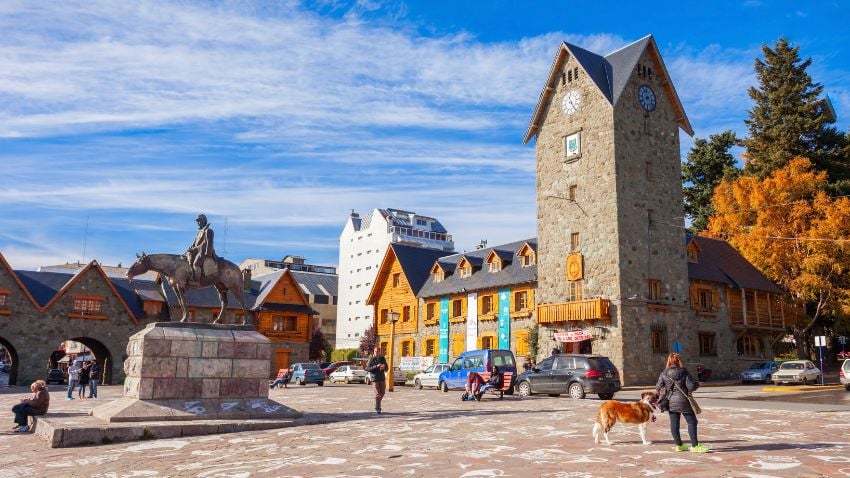
The Bariloche Civic Centre
DURATION FOR THE ARGENTINE RETIREMENT VISA
An Argentine retirement visa is valid for one year and may be renewed annually for up to three years. Following these renewals, you may apply for permanent residence.
After two years of holding a permanent residence visa, you can apply for Argentine citizenship. It is crucial to emphasize that those with the Argentina retirement visa are not permitted to work as employees but to form a company or operate independently.
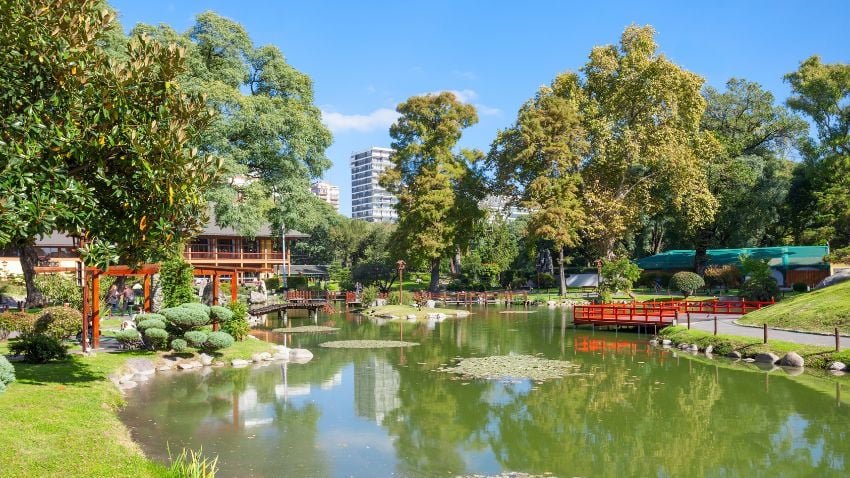
Buenos Aires, Japanese Gardens
THE ADVANTAGES OF RETIRING IN ARGENTINA
LIVING EXPENSES
Argentina may not be the cheapest country in South America. Still, for those who receive in USD and Euro, you can live lavishly for a fraction of what it would cost you in your home country. Depending on your lifestyle and where you live, you may live comfortably without spending much money on food, transportation, or rent.
Estimated monthly living costs in Argentina vary depending on lifestyle and location:
-
Modest/budget lifestyle (single person): $1,000–$1,400 USD per month — includes a small apartment outside prime neighbourhoods, mostly home-cooked meals, use of public transportation, and limited dining out.
-
Comfortable lifestyle (single person): $1,500–$2,200 USD per month — covers a well-located one-bedroom apartment, regular restaurant meals, private healthcare, and occasional travel.
-
Premium/upscale lifestyle (couple, areas such as Palermo or Recoleta): $2,800–$4,500 USD per month — includes a larger two-bedroom apartment in a top neighbourhood, frequent dining out, private insurance, and a vehicle or regular use of ride-sharing services.
Housing costs vary widely depending on location and property type, but rental prices typically reflect the lifestyle tiers outlined above.
The "Paris of the South" value proposition remains compelling for USD earners. Buenos Aires rent is approximately 65% cheaper than New York City and 45% cheaper than London for comparable apartments. The city offers world-class cultural infrastructure, opera, theatre, fine dining, international schools, and private healthcare at a cost structure that remains dramatically below that of equivalent European or North American cities.
THE CLIMATE AND WEATHER
Living in Argentina will expose you to a wide range of climates all year. Argentina's climate may be warm, temperate, arid, or cold. The country spans approximately 3,700 km from north to south, producing climate zones ranging from subtropical in the northeast (Misiones, Chaco), to arid Patagonian steppe in the south, to the temperate coastal climate of Buenos Aires. The highland wine region of Mendoza offers warm summers, mild springs, and cool winters. Bariloche in Patagonia provides access to world-class skiing and spectacular lake district landscapes. You might live in locations where it is bright and pleasant or in colder regions where cooler temperatures are more prevalent.
FRIENDLY PEOPLE
Argentines are typically polite and welcoming to outsiders, so you will have no trouble establishing new acquaintances there. They are well-known for being spontaneous, loving, and affectionate.
There are many more cultural aspects to Argentina that can only be experienced living there, as each country and city is unique in its own way. Buenos Aires specifically maintains one of the most internationally minded expat communities in Latin America, language exchange programs, cultural events, and a vibrant café-and-restaurant culture that facilitates immediate social integration.
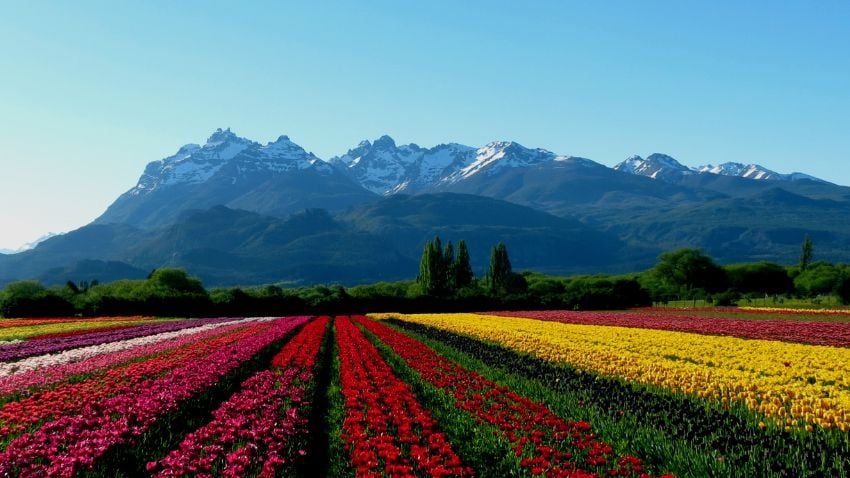
Tulips Field In Patagonia
BEST CITIES TO RETIRE IN ARGENTINA
Argentina has many areas, such as Buenos Aires, Córdoba, the quiet, relaxed, wealthy province of Mendoza, Rosario, the large, comfortable, leisure-filled activity city, Bariloche, and many more. Argentina can allow you to make a suitable choice, as there is always a place to match your taste and likes, and help you have a great residence and retirement experience.
HEALTHCARE SYSTEM IN ARGENTINA
Argentina's healthcare system is regarded as one of the best in Latin America since it provides free public healthcare to all local and international residents. The “Programa De Atencion Medica Integral” (PAMI) is Argentina's biggest care program. It is run by the government and serves a population of over 4.5 million pensioners nationwide.
Most of the Argentine population chooses public health care because of its many advantages, which are less expensive than accessible private healthcare institutions. Clinics and hospitals. In big cities, hospitals have high standards and provide free services like inpatient and outpatient visits, palliative care, rehabilitation, medical transportation, dental treatment, and many more.
The main problem with the Argentine healthcare system is that it does not provide countrywide coverage, so it is recommended that you get private health insurance with worldwide coverage.
Private prepaga premiums have increased 50–75% since 2023 in ARS terms due to inflation and rising expat demand. Budget accordingly and obtain current quotes directly from providers before finalizing your residency budget
Private healthcare in Argentina represents exceptional value. Private hospitals in Buenos Aires like Hospital Alemán, Hospital Británico (British Hospital), Hospital Italiano, and Swiss Medical, operate at international standards, with English-speaking staff, modern facilities, and minimal wait times.
Related content: Top 11 Food And Water Independent Countries You Can Live In As An Expat
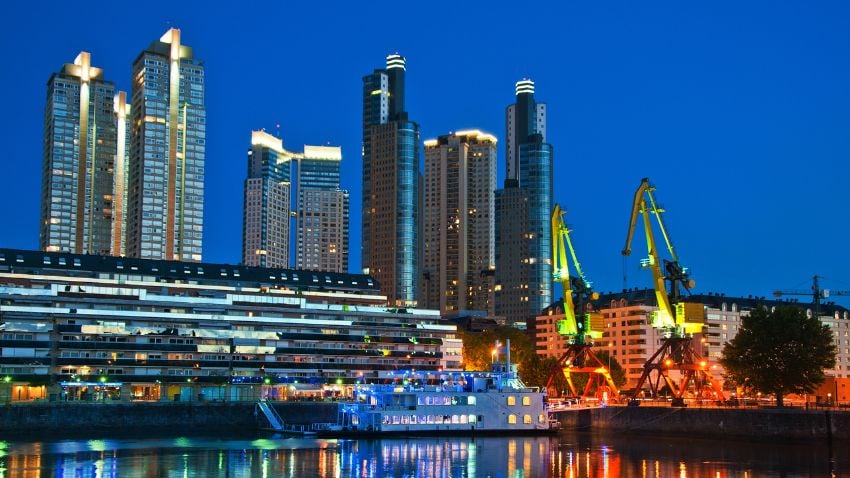
Buenos Aires Skyline at night
THE SOCIAL AND POLITICAL ENVIRONMENT
Argentina’s political landscape is currently defined by President Javier Milei’s libertarian reform agenda, which has gained substantial momentum heading into 2026. Since taking office, Milei has pursued an aggressive program to reduce the size of the state, deregulate the economy, and stabilize Argentina’s long-standing macroeconomic imbalances.
Following a strong performance in the October 2025 midterm elections, his administration consolidated political support and advanced key reforms, including the approval of a landmark labour market modernization law in February 2026. This legislation is part of a broader effort to increase labour flexibility, attract investment, and boost formal employment.
Milei’s economic strategy has centred on fiscal austerity, inflation control, and structural reforms, including cuts to public spending, the elimination of subsidies, and the simplification of regulations. While these measures have been praised by supporters for restoring market confidence, they have also generated social and political tensions due to their short-term impact on purchasing power and public services.
Looking ahead, the government has outlined an ambitious legislative agenda, with 90 initiatives planned for 2026, signalling its intent to deepen reforms and reshape Argentina’s economic and institutional framework.
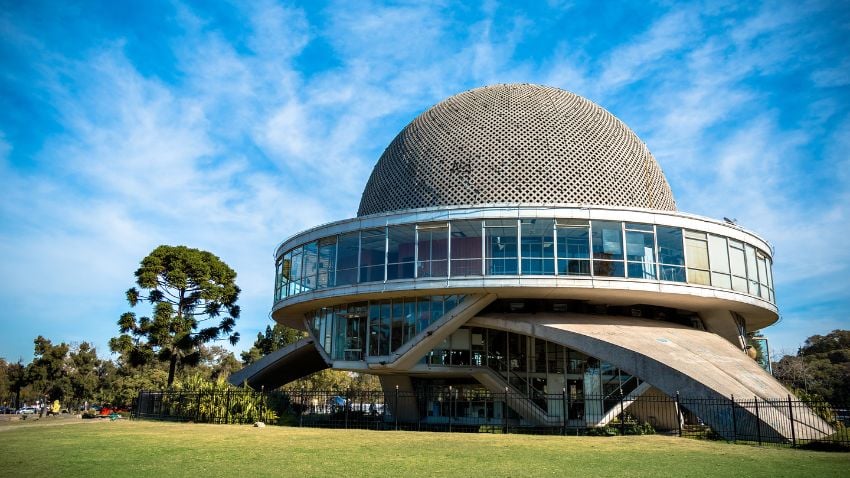
Planetarium, Buenos Aires
SAVINGS AND INCOME TAXES
If you expect to live off your savings in Argentina, the government does not levy taxes on a regular income. Argentina is a nation of taxes, which means that if you want to work again, even though you may still retire in Argentina, you'll have to pay surcharges ranging from 5-35%, according to the ARCA website.
However, the applicable taxes are flexible and progressive (as previously stated, on a 5-35% scale) based on net income and the actual amount of money you make.
What kind of variance in income taxes can you anticipate in Argentina if you live partially on your pension allowance? For example, if you are charged less than 35% of your income, which is the projected amount you should be charged, the difference between the 35% quota and what has been or has not been charged the previous month will be charged the next month.
There is also what is known as variación de Haber, which applies to retirees if their income changes for any reason, if they obtain a retroactive (temporary wage raise or if they've got any extra-economic gain in their favour.) If this is the case, you may see some tax adjustments.
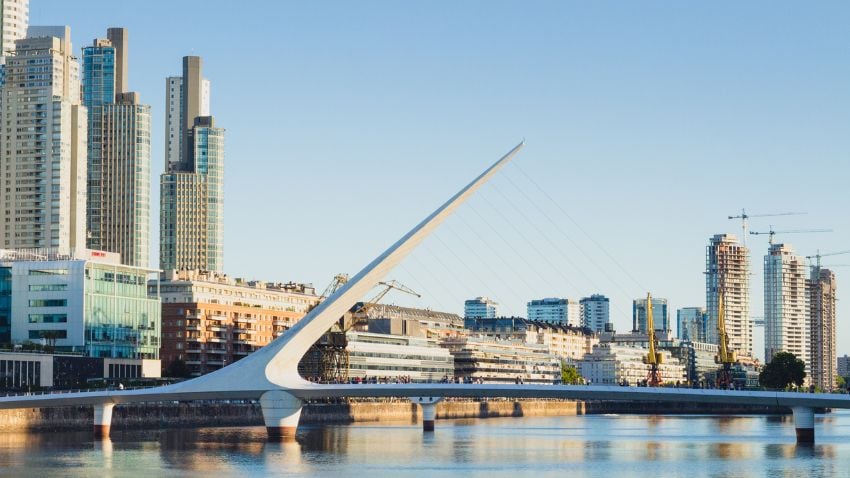
Puerto Madero, Argentina
CONCLUSION
The Argentine government has made obtaining a visa a relatively simple procedure. With everything Argentina offers, it is an excellent option for spending your golden years. You'll have a great time here since there are alternatives for all personalities, preferences, and cultural backgrounds.
The era of extreme currency arbitrage is over. What remains is a structurally sound, culturally extraordinary destination that rewards those seeking a culturally rich, professionally connected, and genuinely affordable second home in Latin America, with a clear path to a second citizenship and passport. Argentina remains in the top tier of global options.


%20Brazil%20The%20Cash%20Cow%20Opportunity%20That%20I%20Couldn%E2%80%99t%20Ignore%20Any%20Longer-1.jpg?width=800&height=429&name=(BLOG%20BANNER)%20Brazil%20The%20Cash%20Cow%20Opportunity%20That%20I%20Couldn%E2%80%99t%20Ignore%20Any%20Longer-1.jpg)


















 Mikkel Thorup: October 12, 2026